CapMonster Cloud API
 Extension for browsers



5 Best reCAPTCHA Alternatives in 2026 (Incl. Cloudflare Turnstile)

Google reCAPTCHA has long been the default bot-protection layer for millions of websites. But in 2026, that default is being seriously questioned — by privacy regulators, frustrated users, and security teams watching AI-powered bots bypass it at scale.
If you're evaluating recaptcha alternatives for your site, this guide compares five strong contenders across security effectiveness, UX friction, privacy compliance, accessibility, and pricing. You'll find a detailed breakdown of each solution, honest pros and cons, and a full comparison table to help you make the right call faster. These are the best recaptcha alternatives available right now.

Why reCAPTCHA Is No Longer Enough
Google reCAPTCHA's 2025 migration to Google Cloud Platform changed its pricing model significantly. The free Essentials tier is now capped at 10,000 assessments per month; Standard costs $8/month for up to 100,000; and Enterprise charges $1 per 1,000 assessments above that threshold — costs that compound fast at scale.
Beyond pricing, reCAPTCHA's privacy profile has attracted regulatory scrutiny. The service collects behavioral data, device fingerprints, and browsing signals that feed Google's broader data ecosystem, raising GDPR, CCPA, and LGPD compliance concerns for teams operating across jurisdictions. At the same time, increasingly capable AI-based solvers are steadily eroding its detection reliability against sophisticated bots. The case for exploring google recaptcha alternatives has never been stronger.
What to Look for in a reCAPTCHA Alternative
Before diving into the options, here are the key criteria worth evaluating for any CAPTCHA solution:
- Security effectiveness — How well does it detect and block sophisticated bots, including AI-powered solvers?
- User experience (UX) — Does it introduce visible friction, or work invisibly in the background?
- Privacy compliance — Is it GDPR, CCPA, and LGPD compliant? Does it collect or share user PII?
- Accessibility — Does it meet WCAG 2.1 or 2.2 AA standards to serve all users?
- Pricing — Are there recaptcha alternatives free tiers, and how do paid plans scale with traffic?
- Integration ease — How complex is the setup, and what platforms/frameworks are supported?
1. Cloudflare Turnstile
Cloudflare Turnstile is a drop-in JavaScript widget that validates users without displaying visual puzzles. It evaluates browser environment signals, device characteristics, and behavioral patterns to issue a verification token — most legitimate users will never see a challenge at all, making it an excellent frictionless recaptcha alternative.
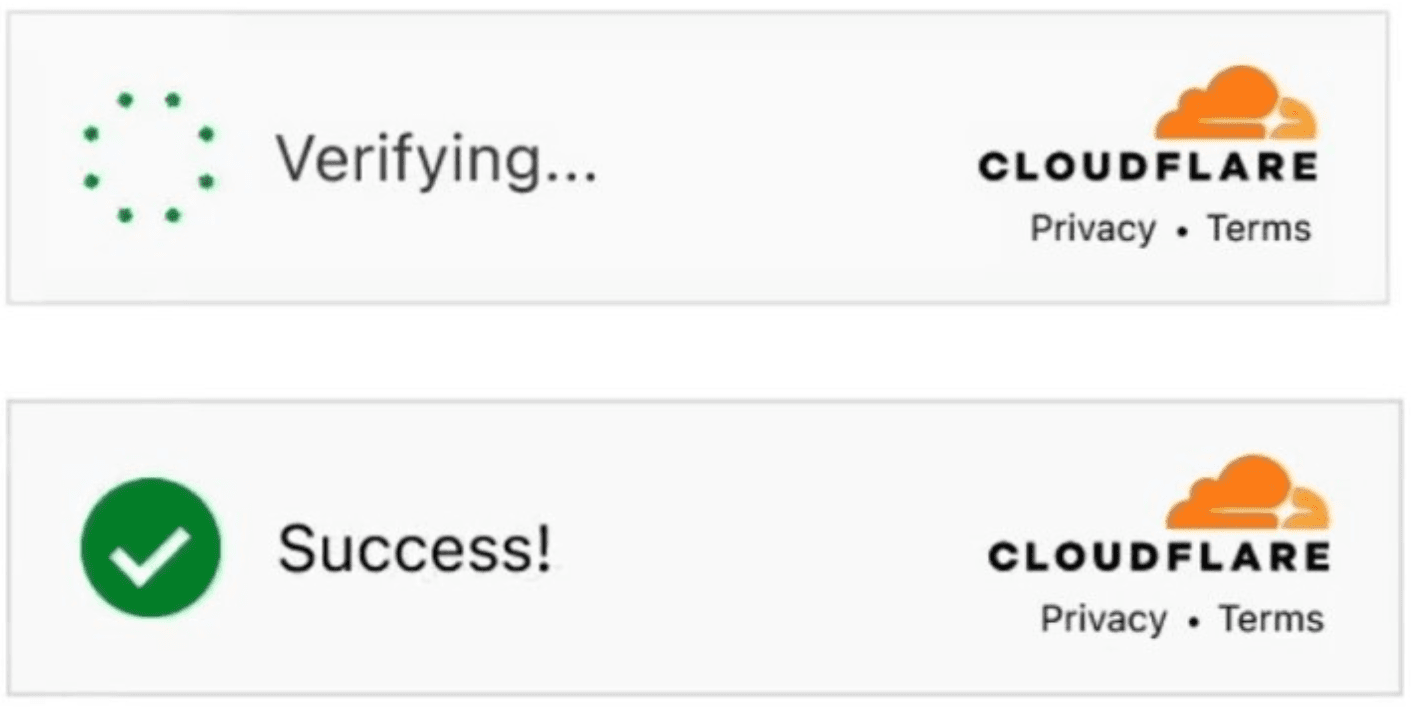
How it works: Turnstile runs client-side JavaScript checks in the background. If the browser signals pass, a token is returned immediately. Borderline sessions trigger a lightweight non-intrusive interactive check (e.g., a checkbox). Three widget modes are available: non-interactive, non-intrusive interactive, and invisible.
✅ Pros:
- Completely free for most use cases (up to 20 widgets, unlimited challenge volume)
- No visual puzzles — minimal friction for legitimate users
- Does not harvest data for advertising purposes, unlike Google reCAPTCHA
- Fast to integrate via a simple script tag
- Can be combined with Cloudflare's WAF for layered perimeter protection
❌ Cons:
- Sharp pricing cliff: free plan → Enterprise at $2,000+/month minimum, with no mid-tier option
- VPN and proxy users can frequently experience friction or failed challenges
- Behavioral signal collection (mouse, keyboard, patterns) may still require GDPR consent mechanisms depending on your jurisdiction
- Detection effectiveness may vary against highly sophisticated, targeted AI bots
Pricing: Free (up to 20 widgets, unlimited challenges); Enterprise — custom pricing (contact sales, typically $2,000+/month)
Best for: General websites, blogs, SaaS signup/login forms — anyone needing a zero-friction, no-cost, Google-free bot protection layer.
2. Funcaptcha (Arkose Labs)
Arkose Labs' Funcaptcha takes a fundamentally different approach. Instead of passive browser signals, it presents interactive 3D game-like puzzle challenges that are trivial for humans but computationally expensive for bots to solve at scale. The adaptive difficulty engine escalates challenge complexity in real time based on risk signals, making it one of the strongest google recaptcha alternatives for high-stakes user flows.
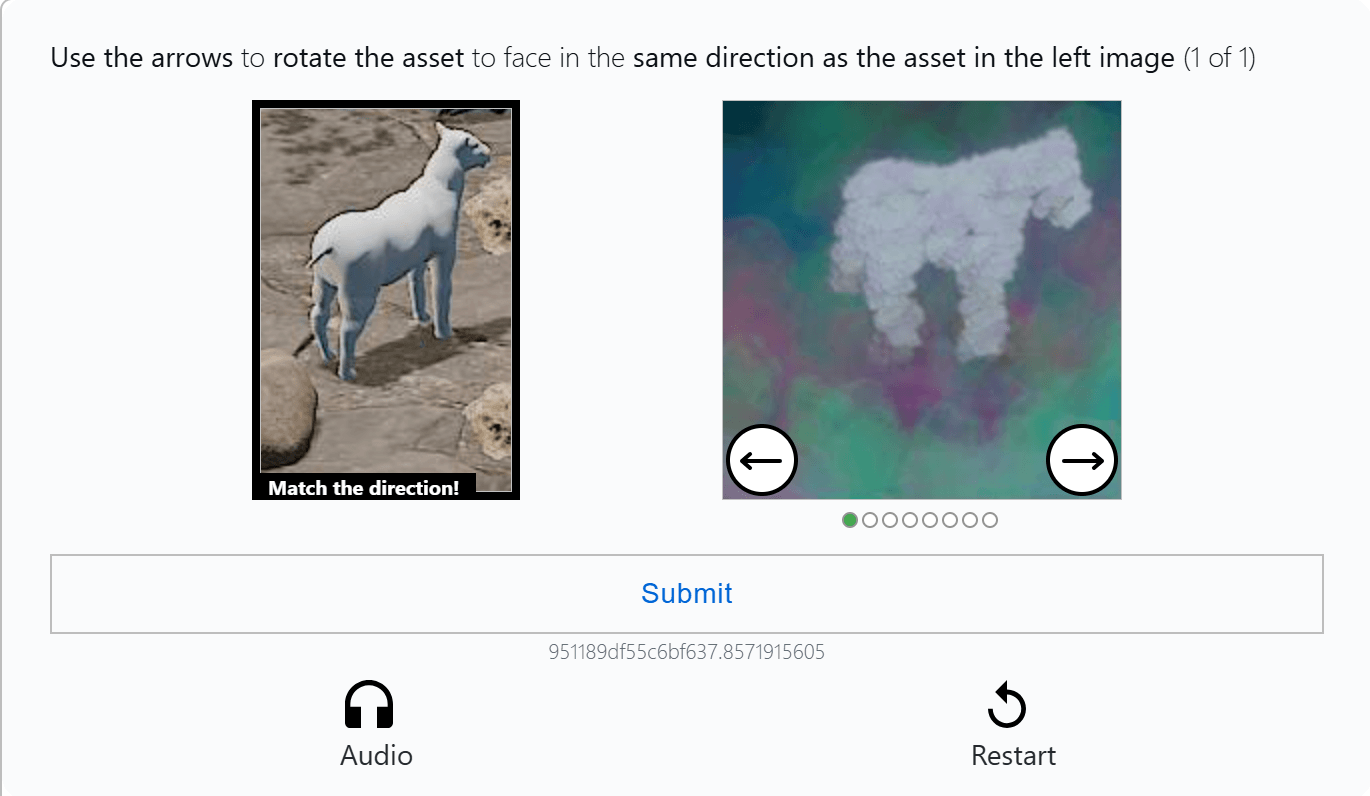
How it works: The Arkose Bot Manager analyzes user behavior client-side. If risk is detected, it serves an Enforcement Challenge — rotating 3D objects, image-matching puzzles, or spatial tasks. Once the user passes, a session token is returned for server-side verification via the Arkose Verify API. Arkose can also operate invisibly for low-risk sessions. Mandatory server-side token verification can help prevent replay attacks.
✅ Pros:
- Extremely resistant to automated solving at scale — high attacker cost-per-solve
- Adaptive difficulty means clearly human users experience very little friction
- Strong fraud prevention layer for account creation, login, and payment flows
- Invisible mode available for low-risk sessions minimizes friction for trusted users
❌ Cons:
- No self-serve pricing — enterprise contract required, making it inaccessible for small projects
- Heavier frontend footprint than invisible-only alternatives
- Interactive challenges, when triggered, add meaningful friction for real users
- Integration requires Arkose Command Center access and production custom domain setup
Pricing: Enterprise/custom — contact Arkose Labs sales
Best for: High-value, high-risk flows (financial services, gaming, large eCommerce) where fraud losses justify enterprise-level CAPTCHA investment.
3. GeeTest
GeeTest is a bot protection platform combining AI-driven behavioral analysis with interactive verification challenges — including sliding puzzles, icon-click challenges, and space challenges. With 7 layers of adaptive defense and an average verification time as low as 1.4 seconds, it strikes a strong balance of security and UX at enterprise scale.

How it works: GeeTest assesses a wide range of behavioral and environmental signals. Low-risk users pass invisibly; higher-risk sessions are served one of up to 9 challenge types calibrated to the detected threat level. Both GeeTest v3 (using gt + challenge parameters) and v4 are widely deployed across enterprise environments.
✅ Pros:
- AI-driven adaptive risk logic significantly raises the cost of bot attacks
- Low average friction — most legitimate users pass with one quick interaction or none at all
- 60+ configurable security strategies for enterprise-specific risk scenarios
- Proven at scale: 360,000+ enterprise customers, securing over 2.9 billion daily requests
❌ Cons:
- Starting from Enterprise tier price makes it inaccessible for small or personal projects
- No fully self-serve onboarding; sales engagement required for deployment
- Data residency and origin considerations may present compliance questions for some EU-only deployments
Pricing: Enterprise usage-based pricing on request
Best for: Large eCommerce platforms, fintech, gaming companies, and other high-traffic enterprises requiring deep customization and proven scale.
4. AWS WAF CAPTCHA
AWS WAF CAPTCHA is not a standalone service — it is a challenge action embedded directly into AWS Web Application Firewall rules. When a rule triggers on a suspicious request, AWS WAF serves a visual or audio CAPTCHA challenge before allowing the request through. For teams already running on AWS, it is one of the most natural recaptcha free alternatives to adopt without adding an external vendor dependency.

How it works: You configure CAPTCHA as a rule action within your WAF Web ACL. Matching requests receive a challenge; users who complete it receive a time-limited bypass token, and their original request is retried automatically. An audio CAPTCHA option is available for users who cannot complete visual challenges.
✅ Pros:
- Native AWS ecosystem integration — no third-party SDK or vendor relationship needed
- Combines WAF IP reputation signals with CAPTCHA for genuinely layered defense
- Audio CAPTCHA supports accessibility requirements out of the box
- Pay-as-you-go model — no subscription minimum beyond baseline AWS WAF fees
- Customizable bypass time window reduces challenge frequency for returning verified users
❌ Cons:
- Tightly coupled to AWS — not a practical option for non-AWS stacks
- Challenge UI is basic with limited visual customization compared to specialized providers
- Total costs can scale unpredictably under high-volume challenge events
- Overall pricing model can be complex to estimate upfront (Web ACL + rule + request fees)
Pricing: CAPTCHA attempts analyzed + Challenge responses served + standard AWS WAF fees (see details on the official Amazon website)
Best for: Engineering teams running AWS-native architectures who want bot mitigation integrated with existing WAF rules — without adding another vendor or SDK.
5. Prosopo (Procaptcha)
Prosopo's Procaptcha is one of the most distinctive entries on this list: a decentralized, open-source CAPTCHA protocol built on blockchain infrastructure (Polkadot/Substrate). Rather than a single corporate authority controlling challenge delivery and validation data, an independent network of providers handles verification — making it a compelling choice for Web3 projects and teams seeking local recaptcha alternatives with true infrastructure independence.

How it works: Prosopo uses a risk-based system that deploys proof-of-work (PoW) or image CAPTCHA depending on detected threat level. The Procaptcha widget is embedded via a <script> tag; after challenge completion, a token is returned for mandatory server-side verification via API.
✅ Pros:
- Decentralized architecture — no single point of failure or corporate data control
- GDPR compliant by design: no centralized PII storage
- Open-source and transparent codebase (Web3 Foundation grant recipient)
- Significantly lower pricing than Google reCAPTCHA at comparable volumes
- Natural fit for Web3 dApps and blockchain-based projects needing on-chain proof of humanity
❌ Cons:
- Smaller ecosystem and community compared to established mainstream providers
- Web3 infrastructure dependency may be unfamiliar to traditional web developers
- Documentation and enterprise support are still maturing relative to older platforms
- Self-hosting requires familiarity with Polkadot/Substrate tooling
Pricing: Free for up to 10K requests/month; up to 100K — $34; 200K — $52; 500K — $87; 1M — $121; above 1M: contact for pricing
Best for: Web3 projects, dApps, privacy-first developers, and teams seeking open-source alternatives for recaptcha outside any single corporate infrastructure.
Best reCAPTCHA Alternatives: Full Comparison
A side-by-side overview of all five alternatives to recaptcha across the dimensions that matter most:
Cloudflare Turnstile | Funcaptcha (Arkose) | GeeTest | AWS WAF CAPTCHA | Prosopo | |
Verification method | Invisible JS challenge | Interactive 3D puzzle | AI behavioral + puzzle | WAF rule-triggered challenge | PoW / image challenge |
UX / Friction | Very low | Low–Medium (adaptive) | Very low (avg. ~1.4s) | Medium | Low–Medium |
Privacy compliance | GDPR (consent may be required) | Enterprise DPA available | GDPR-conscious | AWS DPA | GDPR by design |
Accessibility | Basic | Limited public info | Multiple challenge modes | Audio CAPTCHA included | WCAG-aligned |
Free tier | ✅ Yes (20 widgets, unlimited challenges) | ❌ No | ❌ No | ❌ No | ✅ Yes (up to 10K requests/mo) |
Paid pricing | Enterprise: $2,000+/mo | Custom (enterprise only) | Custom (enterprise only) | CAPTCHA attempts + Challenge responses + WAF fees | Over 10K — from $34/mo |
Best use case | General websites, SaaS | High-risk enterprise flows | High-traffic eCommerce, fintech | AWS-native architectures | Web3, privacy-first, open-source |
CapMonster Cloud & CAPTCHA Automation Tools Compared
The five tools above protect websites from bots. But developers, QA engineers, and automation teams often need a complementary capability: programmatic CAPTCHA solving for legitimate use cases such as integration testing pipelines, CI/CD validation, load testing, and verifying that your CAPTCHA token flow works correctly before deployment.
This is the domain of CAPTCHA automation services — and it is where CapMonster Cloud excels as a leading tool for alternatives for recaptcha solving in developer workflows. CapMonster Cloud is an AI-powered CAPTCHA automation service that supports all five protection tools reviewed in this article — Cloudflare Turnstile, Funcaptcha, GeeTest, AWS WAF CAPTCHA, and Prosopo Procaptcha — as well as reCAPTCHA v2/v3/Enterprise, and a broad range of other types. A clean HTTP API with official SDKs for Python, Node.js, C#, and other languages make integration straightforward. Crucially, CapMonster Cloud uses a pay-per-success model: you are only charged for correctly solved CAPTCHAs, not failed attempts. Built-in proxy infrastructure is included for most task types, eliminating the need to manage proxies separately.
CapMonster Cloud Key Advantages
- Very Fast CAPTCHA Solving — CapMonster Cloud uses neural network-based AI solvers that operate in seconds, with no dependency on slow human worker queues. For time-sensitive automation pipelines and CI/CD workflows, this speed advantage directly reduces test execution time and keeps your integrations moving.
- Excellent Accuracy — The AI recognition engine delivers accuracy rates of up to 99% on core CAPTCHA types such as reCAPTCHA v2 and Cloudflare Turnstile. High accuracy means fewer failed solve attempts, lower retry overhead, and more reliable automation runs overall.
- Wide Range of CAPTCHA Types Supported — CapMonster Cloud covers an extensive and continuously growing library of CAPTCHA types: reCAPTCHA v2/v3/Enterprise, Cloudflare Turnstile, Funcaptcha (Arkose), GeeTest v3/v4, AWS WAF CAPTCHA, Prosopo Procaptcha, image-to-text, and more. One service handles the full variety of challenges your automation stack might encounter.
- Low Price for Major CAPTCHAs — With reCAPTCHA v2 starting at $0.60 per 1,000 solves and a transparent pay-per-success billing model, CapMonster Cloud offers competitive pricing for the most common CAPTCHA types. You only pay for successful results, which keeps costs predictable and eliminates waste from failed attempts.
- Built-in Proxy Support — Unlike many competing services that require you to supply and manage your own proxies, CapMonster Cloud includes built-in proxy infrastructure for most task types. This reduces setup complexity and removes an entire operational dependency from your automation workflow.
Conclusion
Choosing the right recaptcha verification alternatives in 2026 depends on your stack, compliance requirements, and risk tolerance:
- Cloudflare Turnstile — best zero-cost, zero-friction option for most general websites
- Funcaptcha (Arkose Labs) — best for high-risk enterprise flows where attack resilience justifies the investment
- GeeTest — best for high-traffic commercial sites needing deep AI-powered customization
- AWS WAF CAPTCHA — best if you're already committed to AWS and want bot mitigation integrated with your existing WAF rules
- Prosopo — best for Web3 projects, open-source advocates, and teams demanding decentralized infrastructure
Whatever protection layer you choose, validating your CAPTCHA integration in automated test pipelines is an essential step before going live. CapMonster Cloud gives developers the tooling to test, benchmark, and automate CAPTCHA flows across all major challenge types — with AI-powered speed, transparent pay-per-success pricing, and broad coverage of every solution in this guide.
👉 Explore CapMonster Cloud → and start solving CAPTCHAs at scale today.