Loading...
Pricing of Imperva Incapsula solution


Inherited a site with a captcha or another protection layer but no access to the source code? In that case you naturally ask: which solution is installed, is it configured correctly, and how can the workflow be tested?
In this article, we have tried to answer all the key questions. The first step in solving the task is to determine which protection system is being used. To do this, you can refer to the list of popular captchas and anti-bot protection systems, where you will find visual examples and key indicators that help you quickly understand what you are dealing with.
If you discover that your site uses Imperva Incapsula, the next step is to study its properties and operation in more detail. In this article, you can also review the instructions on how to integrate Imperva Incapsula so that you fully understand how it functions on your site. This will help you not only understand the current protection, but also properly plan its maintenance.

What is Incapsula
Imperva Incapsula Web Protection is a cloud-based system for protecting websites and applications from external threats. The system uses secure reverse proxies and a Web Application Firewall (WAF) located worldwide on CDN servers. The site is routed through secure Imperva servers, allowing every request to be inspected and malicious activities to be filtered.
How to solve Incapsula via CapMonster Cloud
When testing pages protected by Imperva Incapsula, it is often necessary to ensure that the protection is working correctly and that the system properly filters suspicious traffic.
You can manually check the protection on your site:
- Open the desired page and ensure that Incapsula presents a check.
- Try to access without completing the check — the site should return a 405 error or an additional challenge.
- After passing the check, access should open without errors.
To automate such checks, you can use services like CapMonster Cloud.
CapMonster accepts Imperva challenge parameters (e.g., the _incap_ cookie, data from HTML and scripts), processes them, and returns ready-made valid cookies that can be inserted into a browser or HTTP client.
Working with CapMonster Cloud via API typically involves the following steps:
 Creating a task
At this stage, you pass your API key, captcha type, and its parameters. The service returns a unique taskId, which can be used later to get the result.
 Sending an API request
In the request to solve Incapsula, the following parameters must be specified:
type - CustomTask;
class - Imperva;
websiteURL - address of the main page where the Incapsula is located;
incapsulaScriptUrl (inside metadata) - "incapsulaScriptUrl": "_Incapsula_Resource?SWJIYLWA=719d34d31c8e3a6e6fffd425f7e032f3" — name of the Incapsula js file;
incapsulaCookies (inside metadata) - your cookies from Incapsula. Can be obtained on the page using document.cookie or in the Set-Cookie request header: "incap_sess_*=...; visid_incap_*=..." (see /createTask request example);
reese84UrlEndpoint (inside metadata) - name of the endpoint where the reese84 fingerprint is sent;
userAgent - Browser User-Agent. Pass only actual UA from Windows OS;
Imperva Incapsula recognition using ready-made libraries
The CapMonster Cloud service provides ready-made libraries for convenient work in Python and JavaScript (Node.js).
Python
JavaScript
How to connect Imperva Incapsula to your site
To confidently navigate captcha operation on your site, understand its verification logic, reconnect or reconfigure, we recommend studying this section. It describes the protection connection process — this will help you quickly understand all the nuances.
1. Create an account (use your work email for registration) and go to the Imperva Cloud Security Console.
2. Confirm your email. After logging in, you will be taken to the control panel (you can learn more about working with the Security Console in the documentation).
3. Open the Websites section and enter the real domain of your site.

Important: Do not use localhost, 127.0.0.1, domains like .test, and other non-existent addresses.
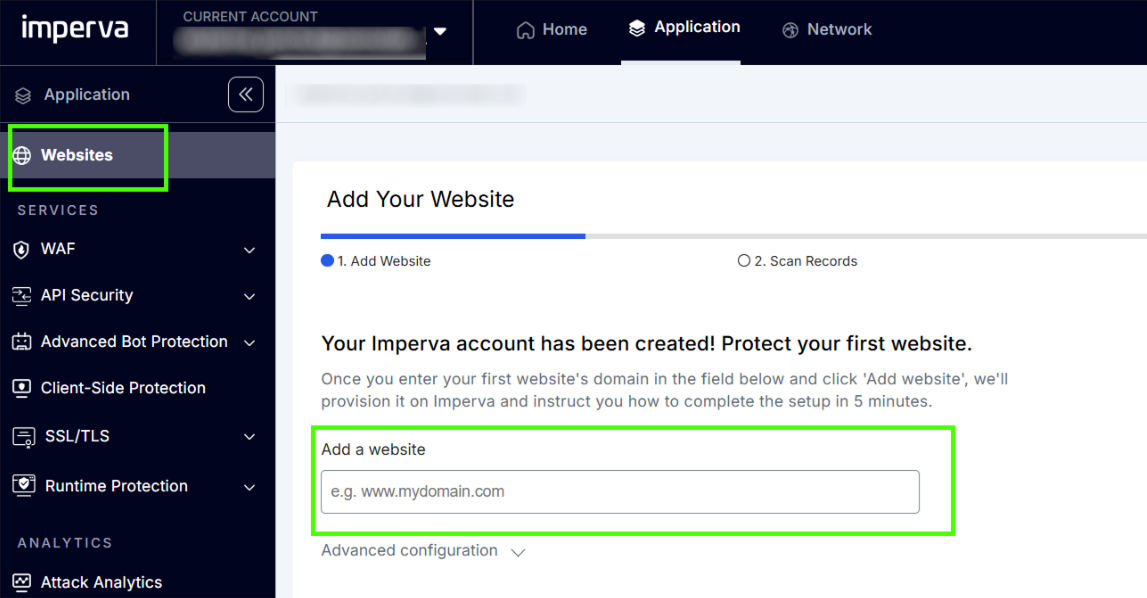
Imperva will automatically:
- detect your DNS provider,
- check SSL,
- start scanning DNS records.
4. Configure DNS records. If Imperva shows the step:
Point dev.mysite.com DNS records to ImpervaDo the following:
- Go to the DNS panel of your registrar or hosting.
- Create or update the record:
Type: CNAME
Name: dev (subdomain you are connecting)
Value: <your_imperva_host>.ng.impervadns.net
Example:
dev.mysite.com > CNAME > xivaxeo.ng.impervadns.net
Possible errors and debugging

Invalid domain or rule — Challenge is not shown.
Check that the Security Rule is bound to the correct domain and path, and that there are no conflicts with IncapRules or ACL.
Page loading or verification timeout.
The browser might not wait for the Imperva response. Increase timeouts in tests and ensure the backend responds quickly enough.
Expired Imperva-cookies.
Outdated visid_incap, incap_ses, nlbi cause a repeated Challenge or blocking.
Excessively sensitive rules.
Strict signatures may block real visitors to your site.
Incorrect configuration.
Incorrect settings or rules that do not take into account site specifics cause erroneous blocks and false positives.
Protection resilience checks
After integration, make sure the system really protects the site from automated actions.

Execute a request without Imperva-cookies. The WAF rule should trigger (e.g., blocking or additional verification according to policy).
Check repeated access with valid cookies. The user should pass without repeated checks if the WAF allows this traffic.
Perform load testing (k6/JMeter). The WAF should consistently process high request volumes and not issue 500/503 errors.
Check behavior with expired or incorrect cookies. Expected result — repeated verification or application of the configured WAF rule.
Security and optimization tips

Configure WAF and Security Policies according to risk level. Use Managed Rules, Bot Protection, and custom rules for more precise control.

Log security events and WAF triggers to identify false positives and analyze blocking reasons.

For transparency, add links to the Privacy Policy and Terms of Use. This is important for transparency and compliance with security requirements.
Supported captchas
 reCAPTCHA v2
 GeeTest
 Cloudflare Turnstile
 DataDome
Conclusion
If you’ve taken over a website that already has a captcha or another protection system installed, but you don’t have access to the code, don’t worry! It’s quite easy to identify which technology is being used. To verify that everything works correctly, you can use the CapMonster Cloud recognition service in an isolated test environment to make sure that the token processing mechanism and the validation logic are functioning properly.
In the case of Imperva Incapsula, it’s enough to detect the system, observe its behavior, and confirm that the protection is working correctly. In this article, we showed how to identify Imperva Incapsula and where to find instructions on how to integrate or reconfigure it, so you can confidently maintain the protection and keep its operation under control.



 Amazon Waf
 Faucet Pay
 Prosopo
 Text CAPTCHA
 Yidun
Yidun MTCaptcha
 Altcha
 Funcaptcha
 TSPD
TSPD Hunt
Hunt Alibaba
 Friendly