Loading...
Pricing of DataDome CAPTCHA solution


Inherited a site with a captcha or another protection layer but no access to the source code? In that case you naturally ask: which solution is installed, is it configured correctly, and how can the workflow be tested?
In this article, we have tried to answer all the key questions. The first step in solving the task is to determine which protection system is being used. To do this, you can refer to the list of popular captchas and anti-bot protection systems, where you will find visual examples and key indicators that help you quickly understand what you are dealing with.
If you discover that your site uses DataDome CAPTCHA, the next step is to study its properties and operation in more detail. In this article, you can also review the instructions on how to integrate DataDome CAPTCHA so that you fully understand how it functions on your site. This will help you not only understand the current protection, but also properly plan its maintenance.

What is DataDome
DataDome is a bot and automated attack protection system that analyzes visitor behavior and network parameters to distinguish real users from malicious traffic and ensure the stable operation of a website or application.

Examples of DataDome CAPTCHA

Behavior analysis
Assessment of user actions (clicks, scrolling, interaction speed).

JavaScript check
Hidden verification of browser and environment.

Network check
Analysis of IP addresses, headers, proxies, and known bot networks.
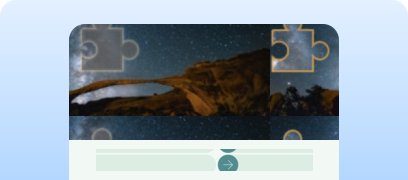
Challenge
Showing CAPTCHA (usually a slider “Swipe right to solve the puzzle”) if the system is unsure.
How to solve DataDome CAPTCHA using CapMonster Cloud
When testing DataDome protection, it is important to ensure that it is correctly integrated and responds to suspicious traffic. For manual verification, open a page protected by DataDome and make sure the system is active.
Try making a request that simulates suspicious behavior (e.g., too frequent page refreshes or submitting a form without valid data) — DataDome should block access or show a protection page.
For automated testing and CAPTCHA solving, specialized services such as CapMonster Cloud can be used — a tool that accepts CAPTCHA parameters, processes them on its servers, and returns a ready solution. This solution (token or cookie) can be inserted into a form or browser to pass verification without user intervention.
Working with CapMonster Cloud via API typically involves the following steps:
 Creating a task
At this step, you provide your API key, CAPTCHA type, and its parameters. The service returns a unique taskId to retrieve the result later.
 Sending an API request
In the request for solving DataDome, you must specify the following parameters:
type - CustomTask
class - DataDome
websiteURL - the address of the main page where the CAPTCHA is solved.
captchaUrl (inside metadata) - "captchaUrl" — the link to the CAPTCHA. Usually in this format: "https://geo.captcha-delivery.com/captcha/?initialCid=..."
datadomeCookie (inside metadata) - Your DataDome cookies. Can be obtained on the page using document.cookie (if the cookies do not have HttpOnly flag), in the request header Set-Cookie: "datadome=...", or directly from the HTML code of the page initialCid.
userAgent - Browser User-Agent. Provide only the current UA from Windows OS.
DataDome CAPTCHA recognition using ready-made libraries
CapMonster Cloud provides ready-made libraries for convenient use in Python and JavaScript (Node.js).
Python
JavaScript
How to integrate DataDome CAPTCHA into your website
To confidently work with CAPTCHA on your site, understand its verification logic, or reconnect/reconfigure it, we recommend reading this section. It describes the integration process and helps you understand all details quickly.
1. Log into your account or sign up with DataDome and obtain the keys (client-side and server-side).
Important: registration requires a corporate email from your company.
After registration, you will enter the admin panel.
2. Add your site (domain) in the DataDome panel.
Add your domain to the system and choose protection parameters:
- Web Protection (HTTP traffic protection)
- Bot detection & mitigation
- Frequency & behavior analysis
- Challenge pages (DataDome verification page)
- JS tag configuration
3. Install server-side integration.
Use Protection API or select a ready-made module for your stack (Node.js / Express, Nginx, Cloudflare, Java (Tomcat/Jetty/Vert.x), Go, etc.).
Install the official DataDome SDK/middleware and configure the server key (server-side key).
Example of DataDome integration in Node.js:
DataDome protects the server from bots and suspicious requests, automatically showing a challenge when necessary. The module can be used with Express or the built-in HTTP server Node.js.
Installation
For Express:
npm install @datadome/module-expressFor Node.js HTTP module:
npm install @datadome/module-httpNode.js version 18 and above is supported. Server-side key from your DataDome panel is required.
 Express integration
const { DatadomeExpress } = require('@datadome/module-express');
const express = require('express');
const app = express();

// Initialize DataDome client
const datadomeClient = new DatadomeExpress('YOUR_SERVER_KEY');

// Connect middleware
app.use(datadomeClient.middleware());

// Your routes
app.get('/', (req, res) => {
  res.send('Hello World');
});

// Start server
app.listen(3000, () => {
  console.log('Server running on port 3000');
})
Possible errors and debugging

Invalid key or domain
DataDome is not properly protecting the site; challenge does not appear. Ensure the correct Server-Side Key is used and the domain is added in the DataDome panel.
Request processing timeout
The server did not wait for a response from the DataDome API. Increase the timeout value in the module settings.
Empty token or invalid parameter
Error submitting verification result to the server. Make sure the client-side JS tag is correctly installed and returns the ddtoken.
Challenge not passed
The request was flagged as suspicious or the token has expired. Enable logging using the module's logger parameter and track blocked and valid events for diagnosis.
Protection resilience checks

Try sending a request to the protected resource without passing the JS Tag or without sending the token. The server should block it (or return a challenge).
Use tools like k6 or JMeter to simulate more than 100 requests per second. The challenge should display correctly and the validation system should remain stable.
Check the server’s behavior when resending an already used token. The server should properly reject the request with status 403 or a challenge.
Security and optimization tips

Store the Server-Side Key only on the server; do not pass it to the client.

Enable event logging via logger or blocked/valid listeners to track reasons for blocks.

Place links to the Privacy Policy and DataDome Terms of Use on form pages, as recommended for transparency to users.
Supported captchas
 reCAPTCHA v2
 GeeTest
 Cloudflare Turnstile
Conclusion
If you’ve taken over a website that already has a captcha or another protection system installed, but you don’t have access to the code, don’t worry! It’s quite easy to identify which technology is being used. To verify that everything works correctly, you can use the CapMonster Cloud recognition service in an isolated test environment to make sure that the token processing mechanism and the validation logic are functioning properly.
In the case of DataDome CAPTCHA, it’s enough to detect the system, observe its behavior, and confirm that the protection is working correctly. In this article, we showed how to identify DataDome CAPTCHA and where to find instructions on how to integrate or reconfigure it, so you can confidently maintain the protection and keep its operation under control.

Helpful links


 Amazon Waf
 Faucet Pay
 Imperva (Incapsula)
 Prosopo
 Text CAPTCHA
 Yidun
Yidun MTCaptcha
 Altcha
 Funcaptcha
 TSPD
TSPD Hunt
Hunt Alibaba
 Friendly